
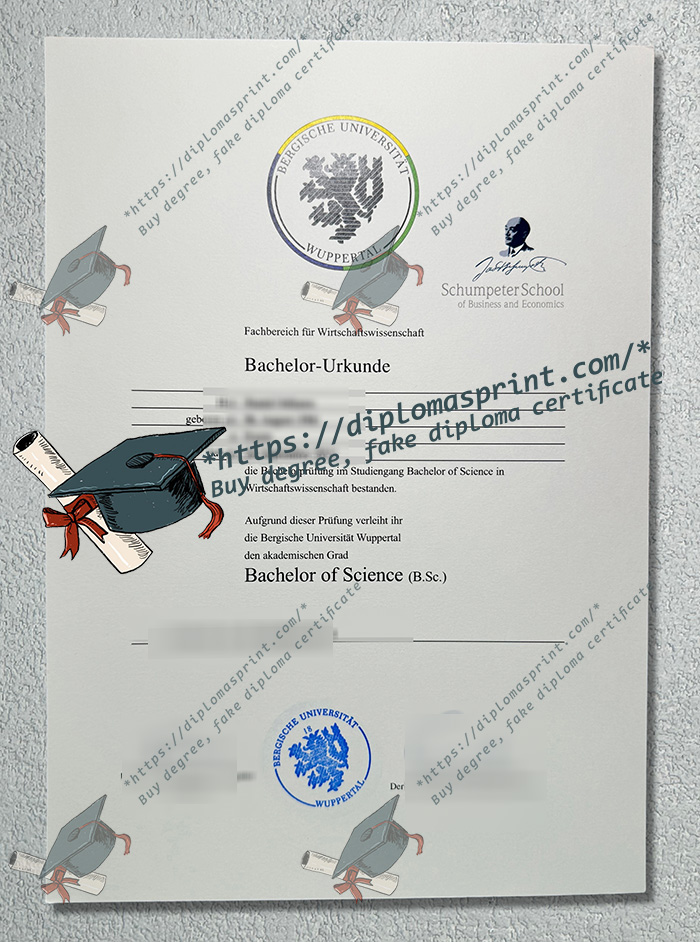
How long to obtain Universität Wuppertal Urkunde, Buy Germany Bachelor of Science Degree, The University of Wuppertal, which in German is Bergische Universität Wuppertal (BUW), is a scientific institution in Wuppertal in the North Rhine-Westphalia.
Established in 1972, it combined existing higher education institutions in the region, such as the Schools of Engineering, Industrial Art and Education and expanded to feature new departments. It now offers combinations of disciplines that are relatively unheard of within the German university system. For example subject combinations for teaching degrees, in interdisciplinary partnerships between the Faculties of Engineering and Economics, or in the Safety Engineering field, where BUW’s degree programme is a one-of-a-kind in Germany. The school offers programmes in English and German.
BUW has three campuses: Grifflenburg (its main campus and housed in an enormous, cut honeycomb concrete structure) and Freudenburg, both of which are in the Wuppertal suburb of Elberfeld, as well as Haspel in Unterbarmen. It is particularly strong in areas of business startup and marketing programmes, which provide young entrepreneurs with a springboard to enter the working world and has granted BUW a high reputation among German universities for several years. Buy Fachhochschule Kiel Urkunde.
Is an Advanced Degree Worth the Work Required?
It’s important to ask yourself: Is it worth it to pursue a master’s degree? In addition to job security, master’s degrees offer other benefits. You become more qualified for certain kinds of jobs, increasing your job security, especially during recessions. A Master’s degree can also get you a better salary than a Bachelor’s degree alone.
Earning a master’s degree is a major investment in your future. It requires significant amounts of work and research, and most universities require that applicants hold a master’s degree before applying for a PhD. However, if you’re not planning on pursuing a PhD, it might not be worth the effort. And if you’re not sure if you’re up for it, consider what barriers may be present in your chosen field.
After you’ve decided that a master’s degree is right for you, identify a career that you’d like to pursue. You can ask current workers what master’s degree programs they’ve taken. If you’re unsure, you can use your network to find opportunities. You can also contact the alumni career center of your undergraduate school. In some professions, there are workers who are willing to mentor others.
Despite its benefits, a master’s degree can be expensive. The median net tuition for master’s programs costs $11,000. Depending on the field of study, some can cost as much as $29,000. Public universities typically have net tuition prices based on prices for state residents. While these figures include the cost of tuition and other required fees, they do not include living expenses.